
If our office is your company’s registered address, here’s how the new AML rules apply to you.
One of the most common arrangements in Australian business is for an accounting practice to provide their office address as the registered office for their clients’ companies. If you’re one of the many clients using our address in this way, the new AML/CTF rules are directly relevant to you.
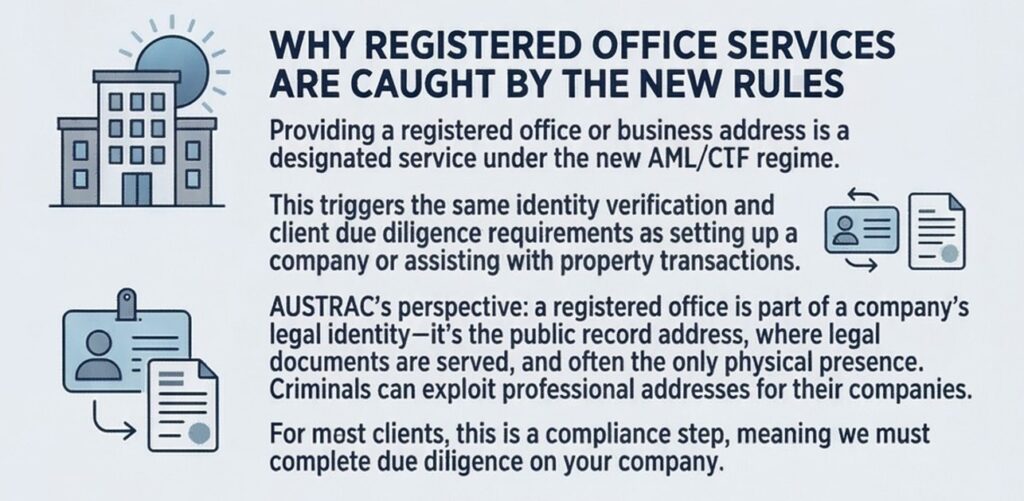
Why registered office services are caught by the new rules
Providing a registered office or business address for a company is classified as a designated service under the new AML/CTF regime. That means it triggers the same identity verification and client due diligence requirements as setting up a company or assisting with a property transaction.
This makes sense from AUSTRAC’s perspective. A company’s registered office is part of its legal identity — it’s the address on the public record, the address where legal documents are served, and in some cases, the only physical presence a company has. Criminals can exploit this by using professional addresses to give shell companies an appearance of legitimacy.
For the vast majority of clients, this is simply a compliance step. But it does mean that if we provide your registered office, they’ll need to complete due diligence on your company as part of their obligations.
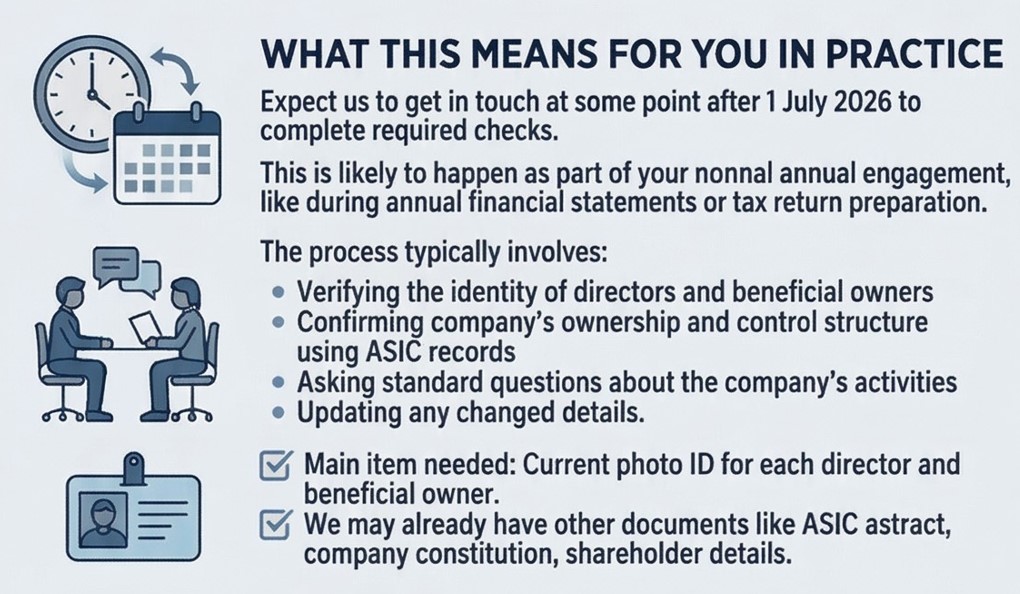
What this means for you in practice
If we already provide your company’s registered office address, you can expect them to get in touch at some point after 1 July 2026 to complete the required checks. This is likely to happen as part of your normal annual engagement — for example, when we prepare your annual financial statements or tax return, they may take the opportunity to complete the AML due diligence at the same time.
The process will typically involve:
- Verifying the identity of directors and beneficial owners (anyone who owns or controls 25%+ of the company)
- Confirming the company’s ownership and control structure using ASIC records
- Asking a few standard questions about the nature of the company’s activities
- Updating any details that have changed since the records were last reviewed
In most cases, we may already have some of the key documents on file — your ASIC extract, company constitution, shareholder details, and director information. They’ll work with whatever records are available and only ask you for anything that’s missing or out of date.
The main item you’ll need to provide is current photo ID for each director and beneficial owner. Beyond that, we should be able to put most of the picture together from our existing records.
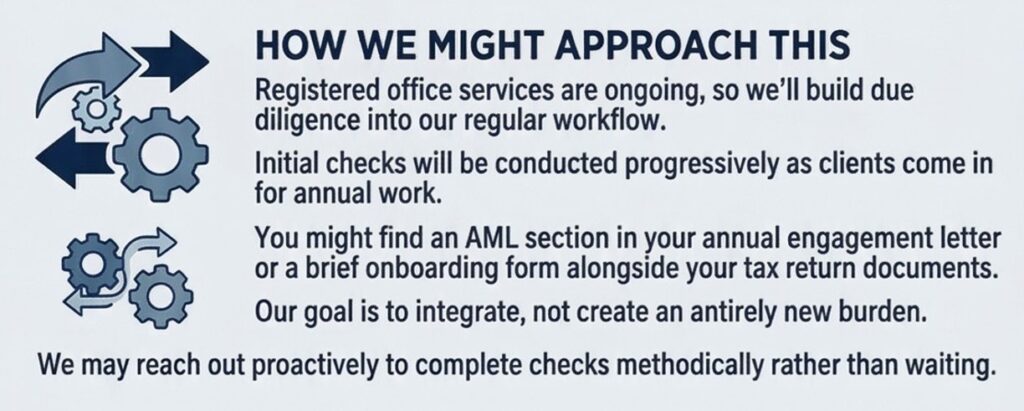
How we might approach this
Because registered office services are ongoing — not a one-off transaction — we’ll need to build the due diligence process into their regular workflow. For most practices, this means conducting the initial checks progressively as clients come in for their annual work.
You might find that we include a short AML section in your annual engagement letter or asks you to complete a brief onboarding form alongside your usual tax return documents. The goal is to integrate the process into work you’re already doing — not create an entirely new administrative burden.
If we provide registered office services for many clients, they may reach out to you proactively to complete the checks. This is simply good practice — working through the client list methodically rather than waiting until the last minute.
What happens if you don’t complete the checks?
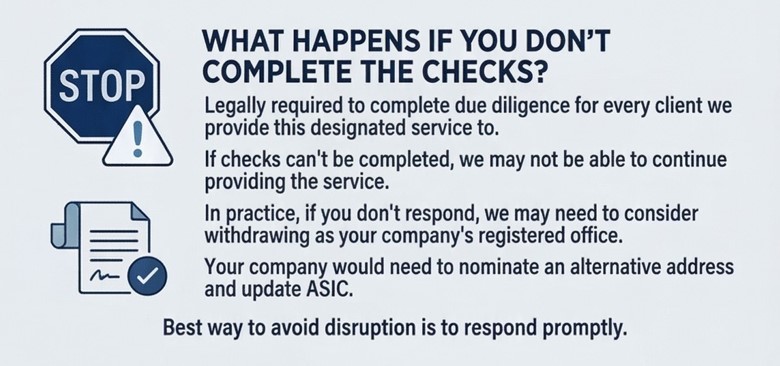
Under the new regime, we’re legally required to complete due diligence on every client for whom they provide a designated service — including registered office. If the checks can’t be completed, we may not be able to continue providing the service.
In practice, this means that if you don’t respond to our requests for information, they may eventually need to consider withdrawing as your company’s registered office. That would require your company to nominate an alternative address and update ASIC.
The best way to avoid any disruption is to respond promptly when we get in touch. For most clients, the process will take no more than a few minutes — especially if our office already has some of the required documents on file.
The key takeaway
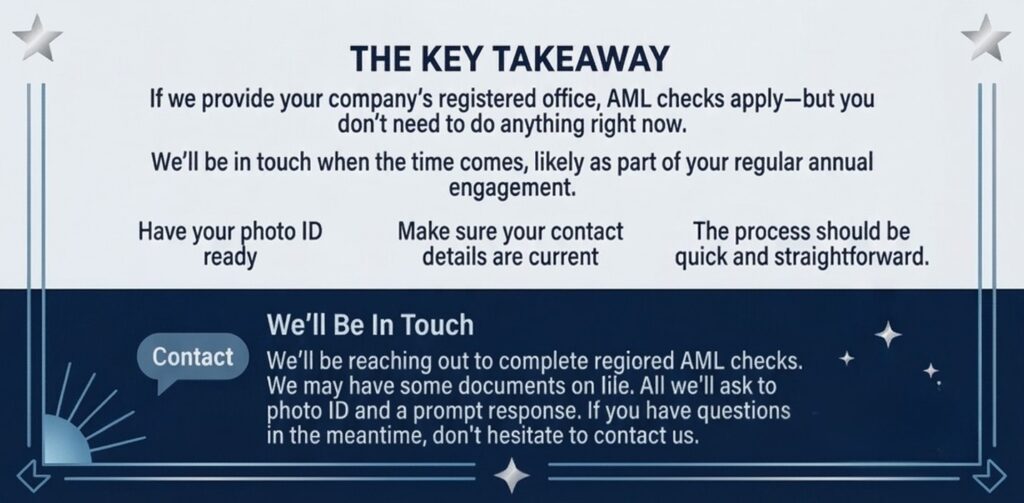
If we provide your company’s registered office, the AML checks will apply to you — but you don’t need to do anything right now. We’ll be in touch when the time comes, most likely as part of your regular annual engagement. Have your photo ID ready, make sure your contact details are current, and the process should be quick and straightforward.
We’ll Be In Touch
If we currently provide your company’s registered office address, we’ll be reaching out to complete the required AML checks — most likely as part of your regular annual engagement. We may already have some of the documents we’ll need on file, so the process should be relatively quick. All we’ll ask is that you have current photo ID ready for each director and beneficial owner, and that you respond promptly when we get in touch. If you have any questions in the meantime, don’t hesitate to contact us.