
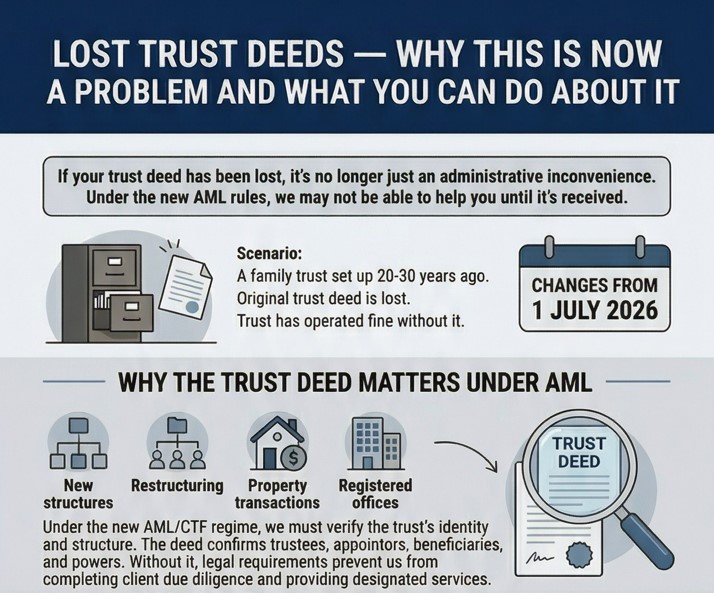
If your trust deed has been lost, it’s no longer just an administrative inconvenience. Under the new AML rules, we may not be able to help you until it’s resolved.
Here’s a scenario that’s more common than most people realise. A family trust was set up twenty or thirty years ago. The original trust deed was signed, filed away somewhere, and hasn’t been seen since. The trust has operated perfectly well for decades — tax returns have been lodged, distributions made, assets held — all without anyone needing to produce the physical document.
That changes from 1 July 2026.
Why the trust deed matters under AML
Under the new AML/CTF regime, when we provide a designated service to a trust — setting up a new structure, restructuring, assisting with a property transaction, or providing a registered office — they’re required to verify the trust’s identity and understand its ownership and control structure. That means they need to sight the trust deed.
The trust deed is the foundation document. It confirms who the trustees are, who the appointor is, who the beneficiaries (or classes of beneficiaries) are, what powers the trustee holds, and what the trust can and cannot do. Without it, we cannot complete the client due diligence that the law requires.
And if we cannot complete the due diligence, they cannot provide the designated service. That’s not a practice policy — it’s a legal requirement.
How trust deeds get lost
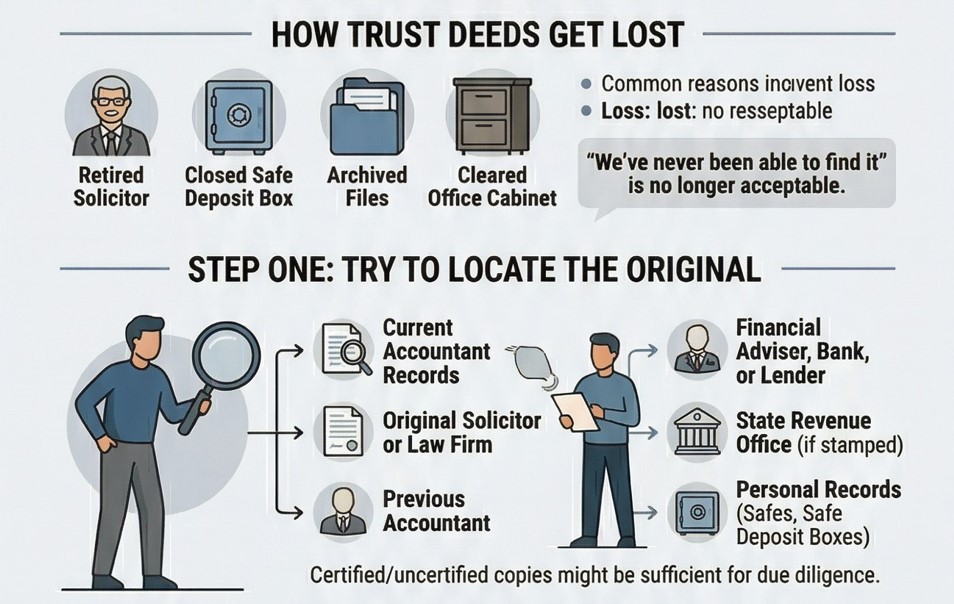
It happens more often than you’d think. The trust was set up by a solicitor who has since retired or closed their practice. The original was held at a previous accountant’s office and was never transferred when the client moved. The deed was kept in a filing cabinet that was cleared out during an office move, or in a safe deposit box that was closed years ago. Sometimes the deed was simply never given to the client after signing.
For years, this didn’t matter much in practice. The trust operated, distributions were made, tax returns were lodged, and nobody asked to see the original. But under the AML regime, the trust deed is a critical verification document — and “we’ve never been able to find it” is no longer an acceptable answer.
Step one: try to locate the original
Before exploring other options, it’s worth making a thorough effort to track down the original deed or a certified copy. Start with your current accountant — some practices may have trust deeds on file and it may simply be a matter of locating the document in the records. If we don’t have it, consider:
The solicitor or law firm that originally prepared the deed
A previous accountant who may have held the deed on file
A financial adviser, bank, or lender who may have been given a copy during a loan or investment application
The State Revenue Office — if the deed was stamped, a copy may be on record
Personal records — safe deposit boxes, home safes, or archived files
If a certified or even uncertified copy can be located, that may be sufficient for us to complete our due diligence — though this will depend on the circumstances and our risk assessment.
If the deed genuinely cannot be found
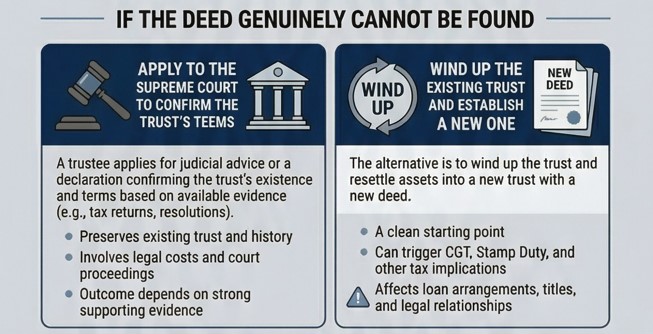
If the original trust deed is truly lost and no copy can be located, you have two main options. Both involve legal advice from a solicitor, and we can help you understand which path makes sense for your situation.
Option 1: Apply to the Supreme Court to confirm the trust’s terms
A trustee can apply to the Supreme Court in their state or territory for a judicial declaration confirming the existence and terms of the trust. This is sometimes called an application for “judicial advice” or a “construction application.” The court can make orders confirming the trust’s provisions based on available evidence — such as historical tax returns, distribution resolutions, correspondence, and the recollections of the parties involved.
This option preserves the existing trust, its history, and its tax position. However, it does involve legal costs and court proceedings, and the outcome depends on the strength of the supporting evidence. Your solicitor will advise whether this path is viable in your circumstances.
Option 2: Wind up the existing trust and establish a new one
The alternative is to wind up the existing trust and resettle the assets into a new trust with a fresh deed. This gives you a clean starting point — a new trust deed that is properly documented, properly executed, and available for inspection whenever required.
However, this option is not without consequences. Winding up a trust and resettling assets can trigger capital gains tax, stamp duty, and other tax implications depending on the assets held, the state or territory, and the structure of the new trust. It may also affect loan arrangements, property titles, and other legal relationships tied to the original trust.
This is not a decision to make lightly, and it requires careful planning with both us and a solicitor to understand the full implications before proceeding.
Why this needs to be addressed now — not later
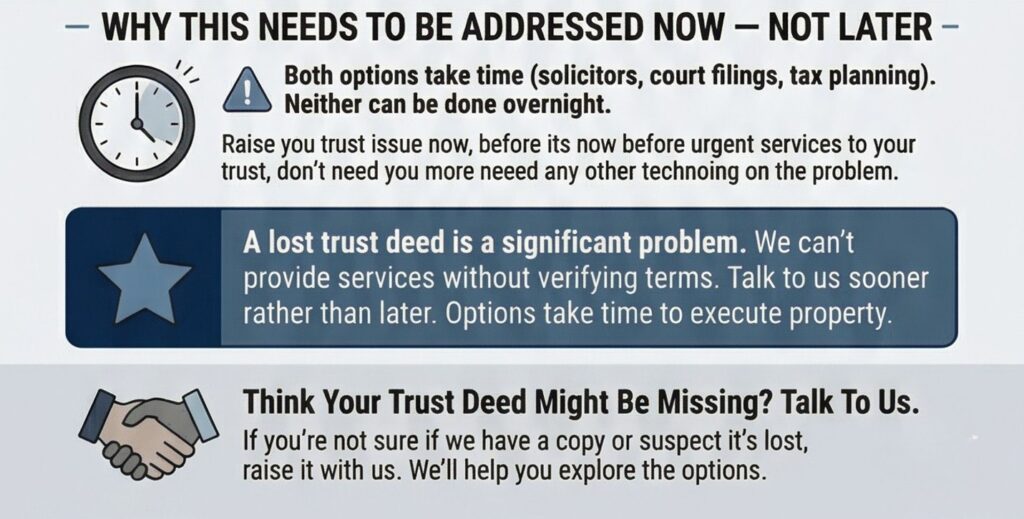
Both options take time. A Supreme Court application involves solicitors, court filings, and a hearing. Winding up and resettling a trust requires careful tax and legal planning. Neither can be done overnight.
If you know your trust deed is missing, the worst time to deal with it is when you urgently need us to provide a designated service — and they can’t, because the due diligence can’t be completed without the deed.
Raise it with us now. They can help you assess the situation, check whether a copy exists in their records or can be tracked down, and — if it genuinely can’t be found — work with you and a solicitor to determine the best path forward before the deadline puts you under pressure.
The key takeaway
A lost trust deed is no longer something you can put in the too-hard basket. Under the new AML/CTF regime, we cannot provide designated services to a trust without being able to verify the trust’s terms — and that means sighting the deed. If yours is missing, talk to us sooner rather than later. The options are there, but they take time to execute properly.
Think Your Trust Deed Might Be Missing? Talk To Us.
If you’re not sure whether we may have a copy of your trust deed on file, or if you suspect the original may have been lost, please raise it with us sooner rather than later. We may already have a copy in our records. If we don’t, we’ll help you explore the options — whether that’s tracking down a copy, seeking a Supreme Court declaration, or considering a new trust structure. The important thing is not to leave it until you urgently need a designated service and discover the deed can’t be found. A quick conversation now could save you a lot of stress later.