
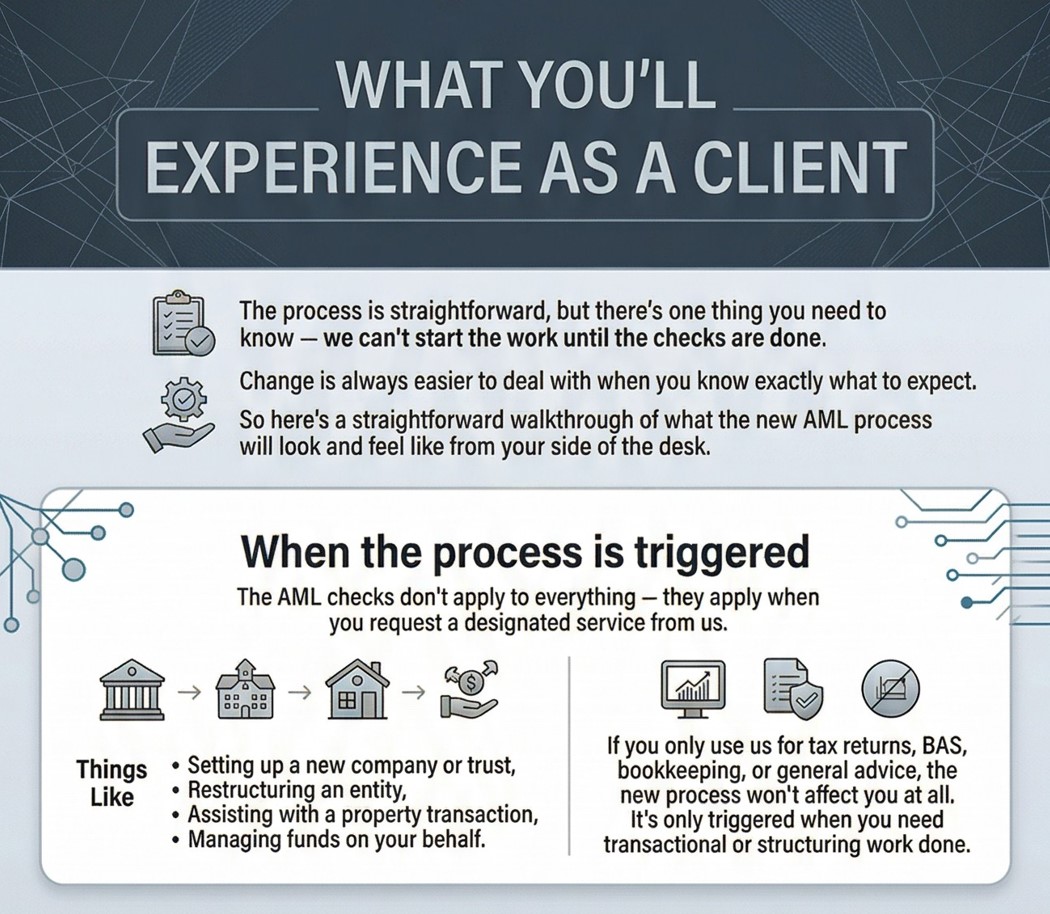
The process is straightforward, but there’s one thing you need to know — we can’t start the work until the checks are done.
Change is always easier to deal with when you know exactly what to expect. So here’s a straightforward walkthrough of what the new AML process will look and feel like from your side of the desk.
When the process is triggered
The AML checks don’t apply to everything — they apply when you request a designated service from us. That means things like setting up a new company or trust, restructuring an entity, assisting with a property transaction, or managing funds on your behalf.
If you only use us for tax returns, BAS, bookkeeping, or general advice, the new process won’t affect you at all. It’s only triggered when you need transactional or structuring work done.
If you’re a new client
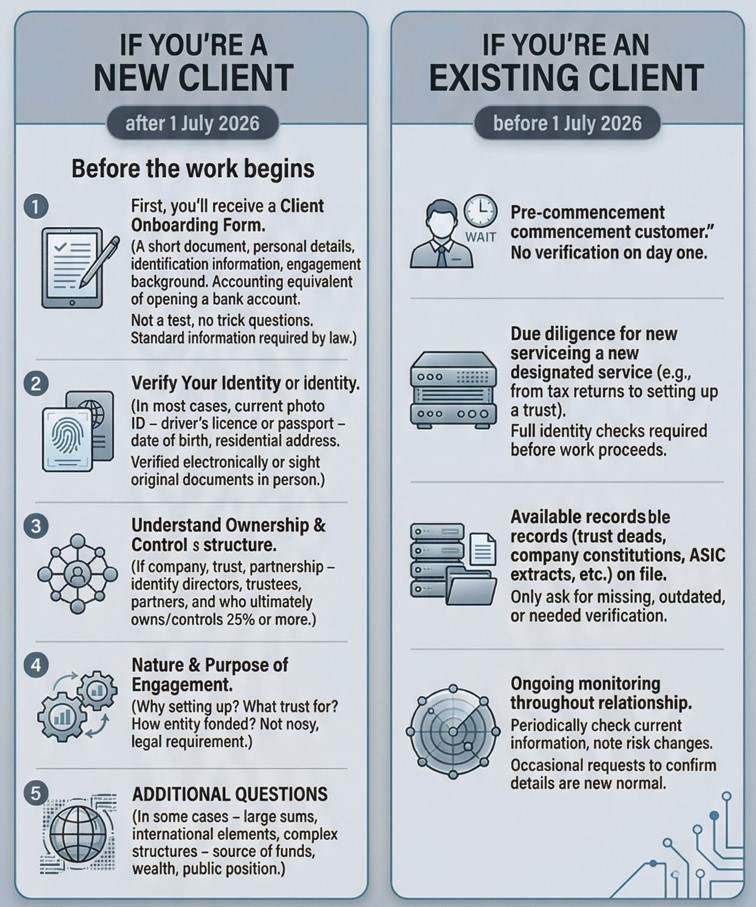
If you’re engaging an accounting practice for the first time after 1 July 2026 and requesting a designated service, here’s what will happen before the work begins.
First, you’ll receive a Client Onboarding Form. This is a short document that collects your personal details, identification information, and some background about the engagement. Think of it as the accounting equivalent of the forms you fill out when you open a bank account. It’s not a test. There are no trick questions. It’s a standard information-gathering exercise required by law.
Second, we’ll verify your identity. In most cases, this means providing a current photo ID — a driver’s licence or passport — along with your date of birth and residential address. We may verify this electronically or ask to sight your original documents in person.
Third, if you’re operating through a company, trust, or partnership, we’ll need to understand the ownership and control structure. This means identifying the directors, trustees, or partners, and who ultimately owns or controls 25% or more of the entity.
Fourth, we’ll ask about the nature and purpose of the engagement. Why are you setting up this company? What’s the trust for? How will the entity be funded? These aren’t nosy questions — they’re a legal requirement.
And in some cases — particularly where the engagement involves large sums, international elements, or complex structures — additional questions about source of funds, source of wealth, and whether you or a close family member hold a prominent public position may be asked.
If you’re an existing client
If you’ve been a client before 1 July 2026, you’re classified as a “pre-commencement customer.” You won’t need to go through any verification process on day one.
The due diligence process kicks in when you request a new designated service — for example, if you’ve always used us for tax returns and BAS, and now you want them to set up a trust or help with a property transaction. At that point, full identity checks will be required before the work can proceed.
In many cases, we may already have key documents on file — your trust deed, company constitution, ASIC extracts, and similar records. Where that’s the case, we’ll use whatever records are available and only ask for anything that’s missing, outdated, or needs to be verified.
We’re also required to conduct ongoing monitoring throughout the relationship — periodically checking that your information is current and noting any changes in risk. This means occasional requests to confirm your details are the new normal.
What ongoing monitoring looks like
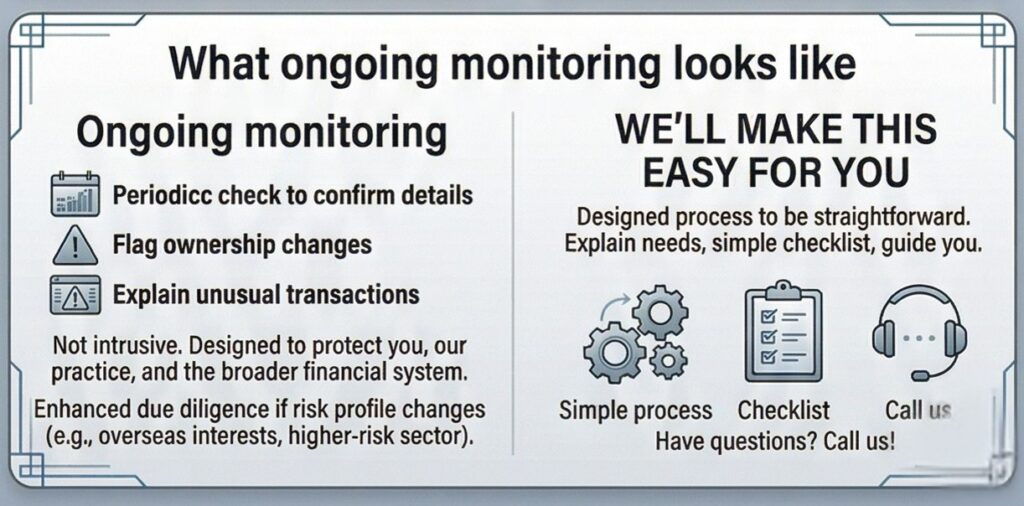
Once the initial checks are complete, the obligations don’t disappear. We may periodically ask you to confirm your details, flag changes to your ownership structure, or explain the background to a new or unusual transaction.
If your risk profile changes — for example, if you acquire overseas interests or begin operating in a higher-risk sector — we may need to conduct enhanced due diligence with deeper checks and more detailed questions.
None of this is designed to be intrusive. It’s designed to protect you, our practice, and the broader financial system.
We’ll Make This Easy For You
We’ve designed our AML process to be as straightforward as possible. When the time comes, we’ll explain exactly what we need, provide you with a simple checklist, and guide you through every step. We may already have some of your key documents on file, so in many cases the process could be quicker than you expect. If you have any questions about what to expect, we’re just a phone call away.