
The new AML requirements don’t affect every client the same way. Here’s what applies to your specific situation.
The practical impact on you depends entirely on how your business or affairs are structured. This guide breaks down what the new AML checks mean for each type of client, what we’ll need, and what to watch out for.
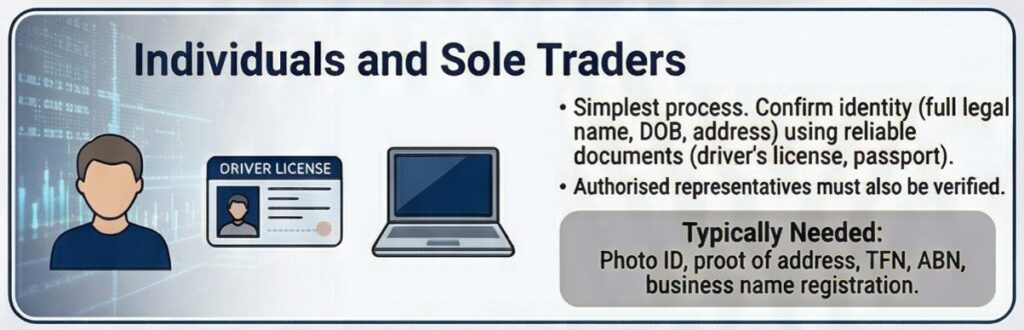
Individuals and Sole Traders
If you operate as an individual or sole trader, the AML process is at its simplest. We need to confirm your identity — your full legal name, date of birth, and residential address — and verify it against a reliable document like a driver’s licence or passport.
You’ll also need your contact details, TFN, ABN, and business name registration details. If someone else is acting on your behalf — an authorised representative, a family member with power of attorney, or an agent — we’ll need to verify that person’s identity and authority too.
What’s typically needed: photo ID, proof of address, TFN, ABN, business name registration.
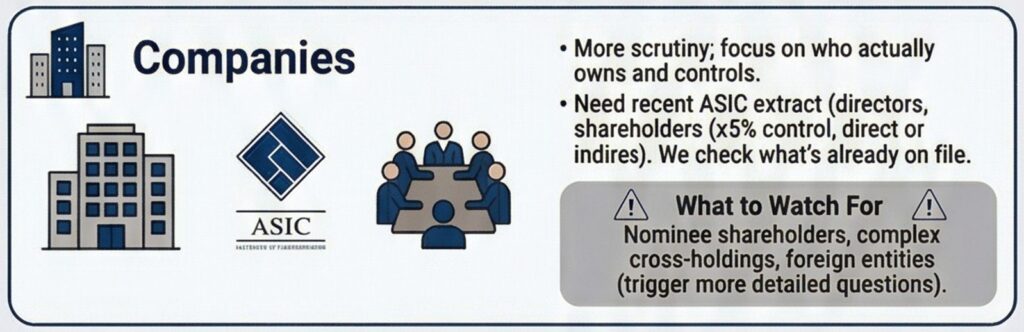
Companies
Companies attract more scrutiny because their structure can obscure who’s really in control. The fundamental question the AML regime asks is: who actually owns and controls this entity?
We’ll need a recent ASIC extract showing directors, shareholders, registered office, and share structure. They must identify every beneficial owner — any individual who ultimately owns or controls 25% or more of the company, whether directly or indirectly through other entities. In many accounting practices, ASIC extracts, company constitutions, and shareholder registers may already be on file — we’ll check what’s available first and only ask for anything that’s outdated or missing.
If your company is owned by another company, which is in turn owned by a trust, we need to follow that chain all the way to the top until they reach the individuals who ultimately call the shots. For companies within a broader group, a group structure chart showing how the entities connect will be needed.
What to watch for: nominee shareholders, complex cross-holdings, or ownership through foreign entities will trigger more detailed questions and potentially enhanced due diligence.
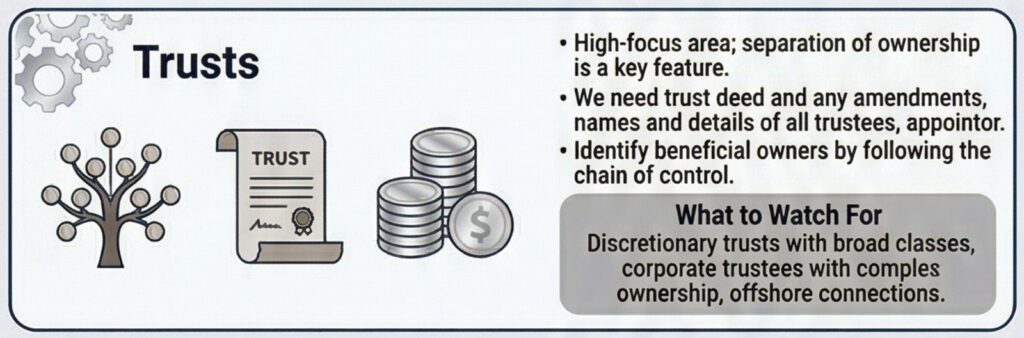
Trusts
Trusts are one of the highest-focus areas under the new AML regime. The features that make trusts useful for asset protection and estate planning — the separation of legal and beneficial ownership, flexible beneficiary arrangements, the role of appointors — are exactly the features that can be exploited to hide asset ownership.
We’ll need the trust deed (and any amendments), the full names and details of all trustees, the appointor or principal, and the beneficiaries or classes of beneficiaries. In many cases, trust deeds, amending deeds, and trustee appointment documents may already be held at our office. We’ll use these records and come to you only for anything that’s not already on file — typically photo ID for key individuals.
If the trustee is a company, the full company identification requirements apply to that entity as well. We must also identify the beneficial owners of the trust — typically by following the chain of control to determine which individuals ultimately control the trust’s assets.
What to watch for: discretionary trusts with broad beneficiary classes, corporate trustees with complex ownership, and trusts with offshore connections will attract heightened scrutiny.
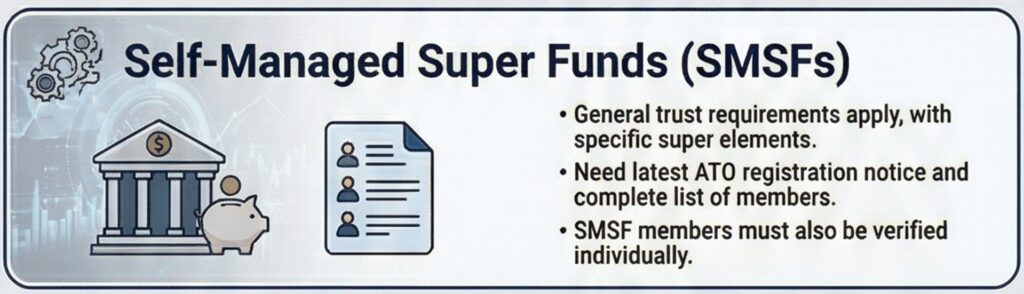
Self-Managed Super Funds (SMSFs)
Because an SMSF is structured as a trust, the general trust requirements apply. But there are additional elements specific to super funds.
You’ll need your latest ATO registration notice confirming the fund’s complying status, along with a complete list of all fund members. Since SMSF members are typically also trustees (or directors of the corporate trustee), identity verification requirements overlap — but each individual still needs to be verified separately. We may already have the trust deed and member details on file.
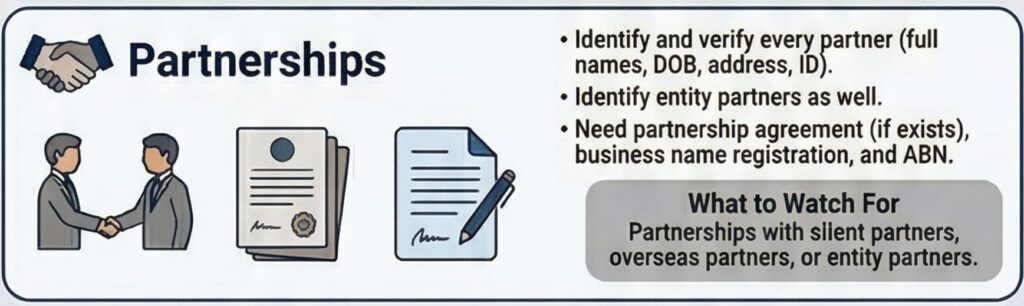
Partnerships
If you operate through a partnership, we need to identify and verify every partner. That means full names, dates of birth, residential addresses, and photo ID for each individual partner.
If a partner is an entity rather than an individual, the identification requirements for that entity type also apply. We’ll need the partnership agreement (if one exists), your business name registration details, and ABN.
What to watch for: partnerships with silent partners, overseas partners, or entity partners will face additional scrutiny.
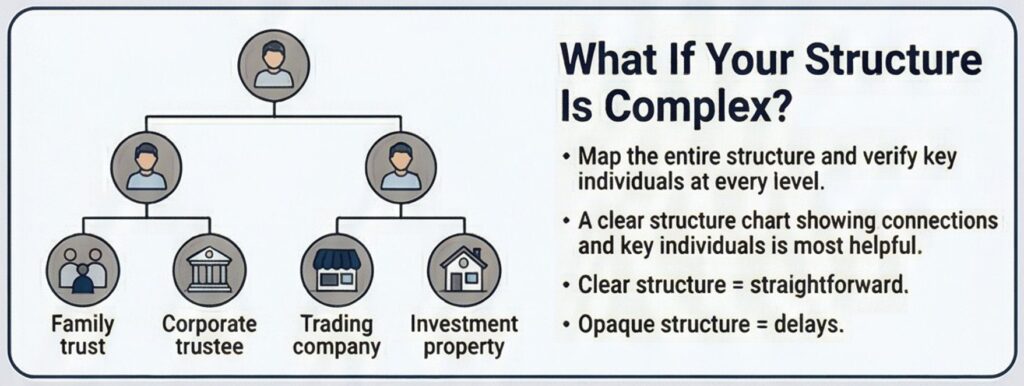
What If Your Structure Is Complex?
If you have multiple entities — say, a family trust with a corporate trustee, which holds shares in a trading company and an investment property — we need to map the entire structure and verify key individuals at every level.
The most helpful thing you can do is work with us to ensure a clear structure chart is on file showing every entity, how they connect, and who the key individuals are. We may already have some of this documentation on file and can help put the picture together.
Complex structures aren’t a problem under the AML regime. Opaque structures are. If the ownership and control can be clearly documented, the process will be straightforward. If it can’t, expect delays.
Let Us Help You Get Sorted
Every client’s situation is different, and we understand that. Whether you operate as a sole trader, through a company, a trust, an SMSF, or a combination of structures, we’ll tailor the AML process to your specific circumstances. We may already have some of your key documents on file, which could make the process more straightforward. If you’d like to have a chat about how the changes apply to your particular structure, get in touch — we’re happy to talk it through.