
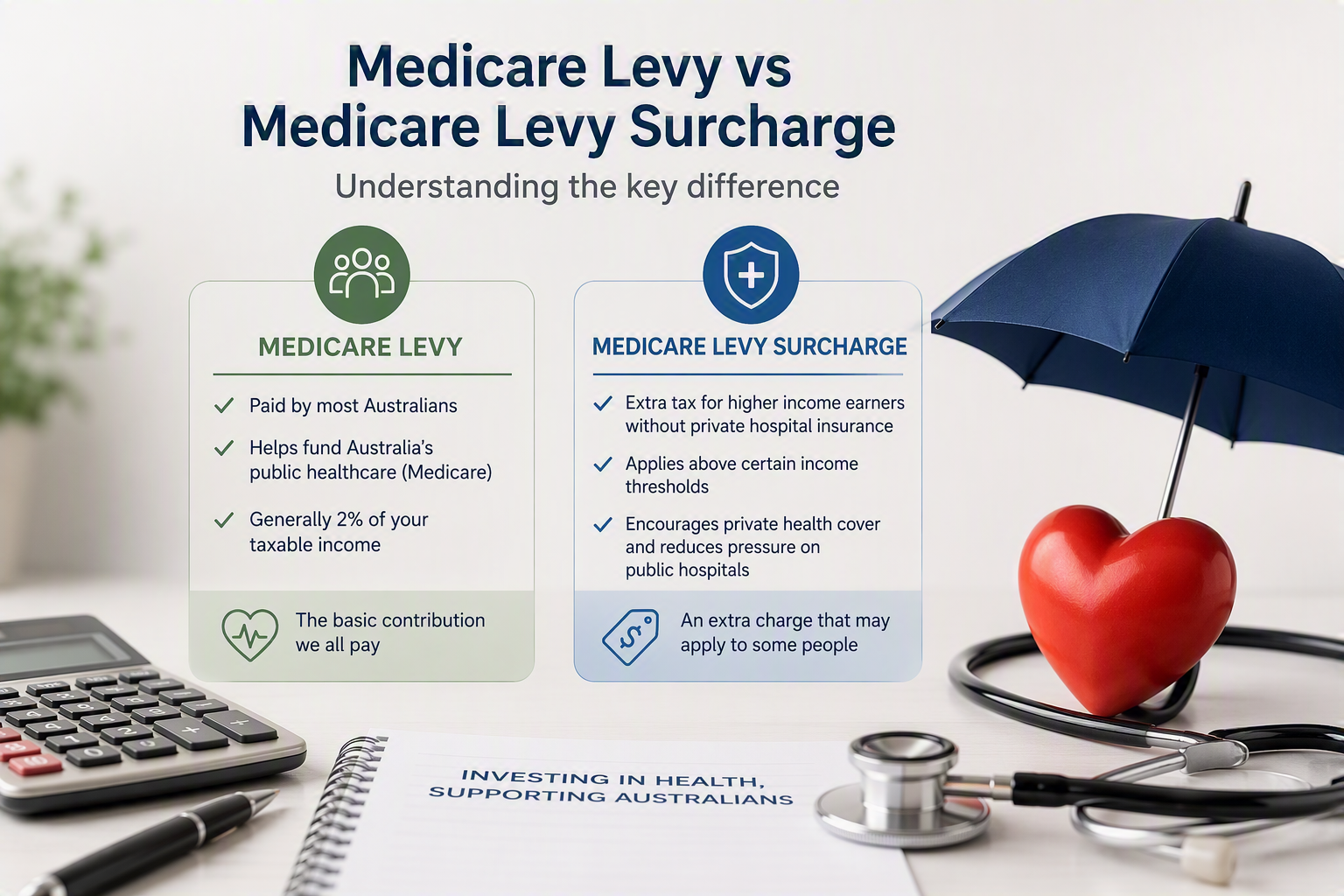
Many Australians are surprised to see both a Medicare Levy and a Medicare Levy Surcharge (MLS) on their tax return. They sound similar, but they are actually two different things.
A simple way to think about it is this:
- Medicare Levy = the basic contribution
- Medicare Levy Surcharge = an extra charge for some higher-income earners
The Medicare Levy helps pay for Australia’s public healthcare system, Medicare. Most Australians pay it, and it is generally 2% of their taxable income. Think of it like everyone chipping in a small amount to help keep the public health system running.
The Medicare Levy Surcharge (MLS) is different. It is an extra tax that may apply if you earn above certain income thresholds and do not have private hospital health insurance. The Government uses this surcharge to encourage higher-income earners to take out private health cover and reduce pressure on the public health system.
Here is an easy example:
Imagine two people each earn $120,000 per year.
Sarah has private hospital cover.
She pays the normal Medicare Levy, but no Medicare Levy Surcharge.
Tom does not have private hospital cover.
He pays the normal Medicare Levy and may also have to pay the Medicare Levy Surcharge because his income is above the relevant threshold.
Think of the Medicare Levy as the entry ticket that most Australians pay to help fund Medicare.
With the Medicare Levy Surcharge as a parking fine. It only applies to certain people who earn above the income thresholds and choose not to have appropriate private hospital insurance.
The important thing to remember is that having private health insurance can help you avoid the Medicare Levy Surcharge, but it does not remove the Medicare Levy itself. Everyone who is liable for the Medicare Levy still pays that amount.