
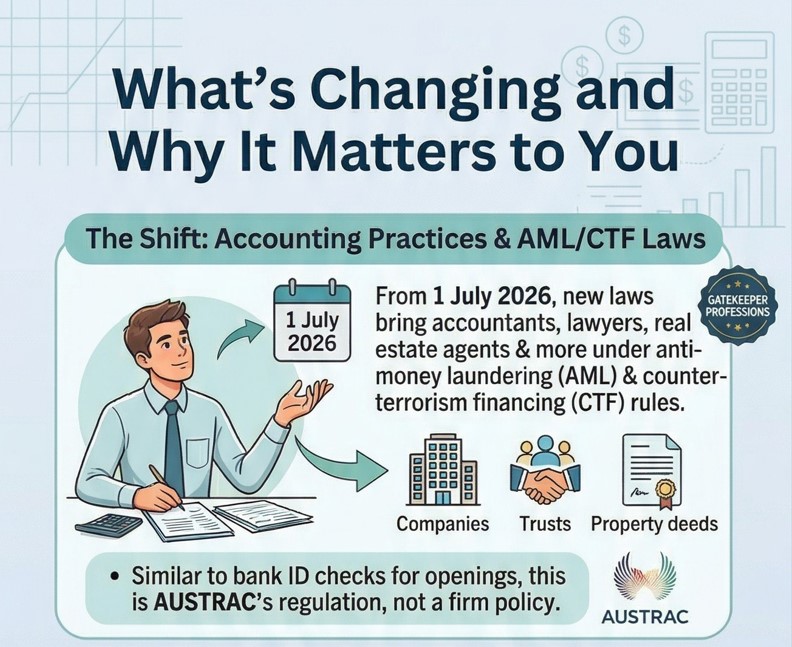
We aren’t asking for more paperwork because they want to. They’re asking because, from 1 July 2026, the law says they have to.
Something significant is about to change in the way accounting practices across Australia operate — and whether you realise it or not, it’s going to affect you as a client.
From 1 July 2026, the Australian Government is bringing accountants, lawyers, real estate agents, and other professional services under the country’s anti-money laundering and counter-terrorism financing (AML/CTF) laws. These professions are known as “gatekeeper professions” because the work they do — setting up companies, structuring trusts, facilitating property transactions — can be exploited by criminals to disguise the origins of dirty money.
Until now, these rules mainly applied to banks and financial institutions. If you’ve ever opened a bank account and been asked for two forms of ID, a proof of address, and an explanation of what the account is for — that’s AML in action. From July, we’ll be doing something very similar.
This isn’t a policy change we chose to make. It’s a legal obligation imposed by AUSTRAC, the Australian Government agency responsible for detecting, deterring, and disrupting financial crime. AUSTRAC now regulates accounting practices in the same way it regulates banks, and the penalties for non-compliance are real.
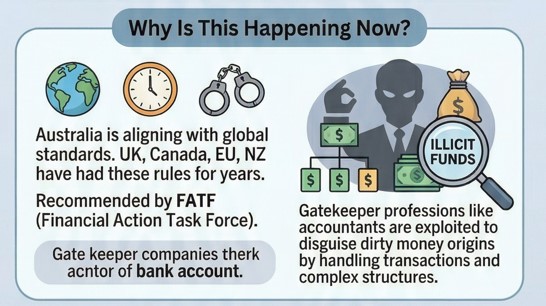
Why is this happening now?
Australia has been behind the rest of the world on this. Most developed countries — the UK, Canada, the EU, New Zealand — have had these rules in place for years. The Financial Action Task Force (FATF), the international body that sets global AML standards, has long recommended that professional service providers be regulated. Australia’s Tranche 2 reforms finally close that gap.
The reason gatekeeper professions are being targeted is straightforward. Criminals don’t walk into a bank with a suitcase full of cash anymore. They use professionals — sometimes knowingly, often unknowingly — to create corporate structures, move money through trust accounts, and buy property in ways that make illicit funds look legitimate. AUSTRAC’s own guidance puts it plainly: accountants are often exploited for money laundering in Australia because they handle large volumes of currency, facilitate international transactions, and create complex structures that can obscure the origins of funds.
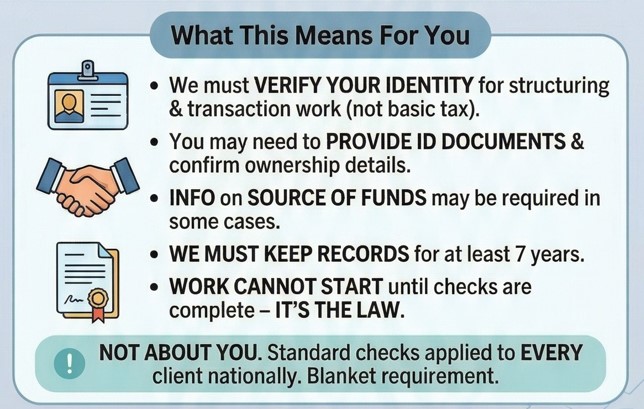
What does this mean for you?
It means that when we help you with certain types of work — the transaction and structuring work, not your regular tax return — they need to verify who you are, understand the purpose of the engagement, and assess whether there are any money laundering or terrorism financing risks involved.
It means you may be asked to provide identification documents, confirm ownership details, and in some cases, provide information about where your money is coming from. It means we’ll need to keep records of all of this for at least seven years and may need to report certain matters to AUSTRAC.
And it means that if the checks aren’t done, the work can’t start. That’s not a practice policy. That’s the law.
Here’s the most important thing to understand: none of this is about you. These are standard checks applied to every client, at every practice, in every state and territory across Australia. It’s not triggered by suspicion. It’s not because something is wrong. It’s a blanket legal requirement, and the sooner you’re prepared for it, the less it will disrupt the work you actually need done.
The good news is that we may already have many of the documents needed on file — trust deeds, company constitutions, ASIC extracts, and entity records are sometimes kept by our practice. When the time comes, we’ll work with whatever records are available and let you know if anything else is needed.
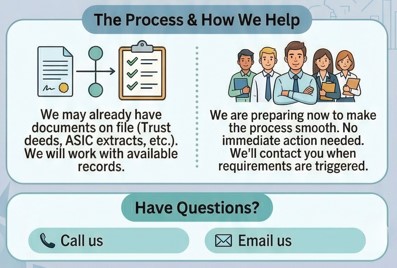
How We Can Help
We know this is a lot to take in, and we want you to know that we’re across it. Our practice is preparing for these changes now so that when the time comes, the process is as smooth as possible for you. You don’t need to do anything right now — we’ll be in touch when a designated service triggers the new requirements. In the meantime, if you have any questions about how these changes might affect you, give us a call or drop us an email. We’d rather have a quick chat now than have you wondering.