
Not everything we do is covered by the new AML laws. Here’s how to tell the difference.
One of the most common questions clients are asking right now is: does this affect everything my accountant does for me?
The answer is no. And understanding the distinction is the single most useful thing you can do to prepare for what’s coming.
From 1 July 2026, Australia’s AML/CTF laws will apply to specific services provided by accountants — what the legislation calls “designated services.” These are the types of work that AUSTRAC has identified as carrying a higher risk of being misused for money laundering or terrorism financing. If we provide one of these services to you, they must complete identity verification and due diligence checks before the work can begin.
But the majority of what most clients use their accountant for — the bread-and-butter compliance and advisory work — isn’t caught by the new rules at all.
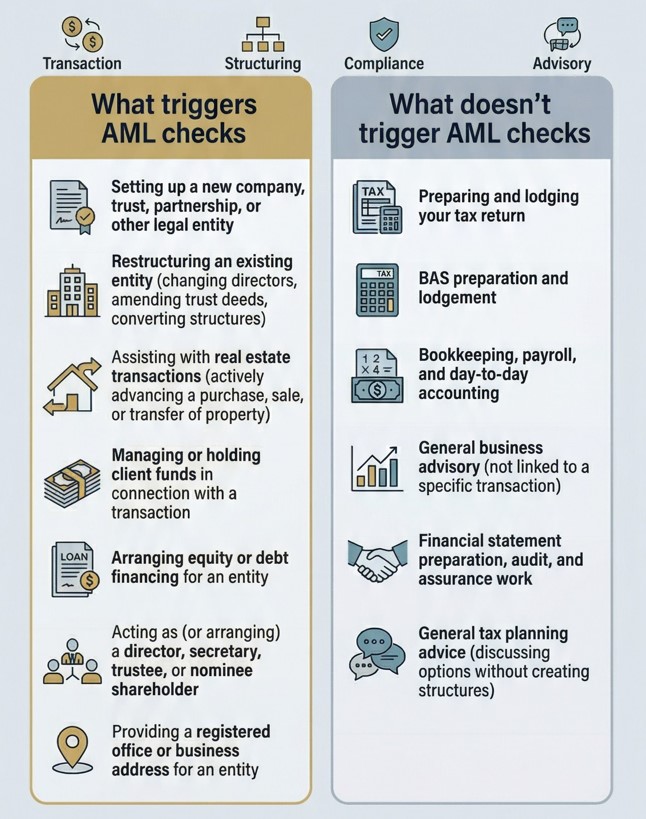
What triggers AML checks
The designated services that apply to accountants relate specifically to transactional and structuring work. In practical terms, these include:
- Setting up a new company, trust, partnership, or other legal entity
- Restructuring an existing entity — changing directors, amending trust deeds, converting structures
- Assisting with real estate transactions — actively advancing a purchase, sale, or transfer of property
- Managing or holding client funds in connection with a transaction
- Arranging equity or debt financing for an entity
- Acting as (or arranging) a director, secretary, trustee, or nominee shareholder on your behalf
- Providing a registered office or business address for an entity
What doesn’t trigger AML checks
The following services are generally not caught by the new regime:
- Preparing and lodging your tax return
- BAS preparation and lodgement
- Bookkeeping, payroll, and day-to-day accounting
- General business advisory — not linked to a specific transaction
- Financial statement preparation, audit, and assurance work
- General tax planning advice — discussing options without actually creating structures
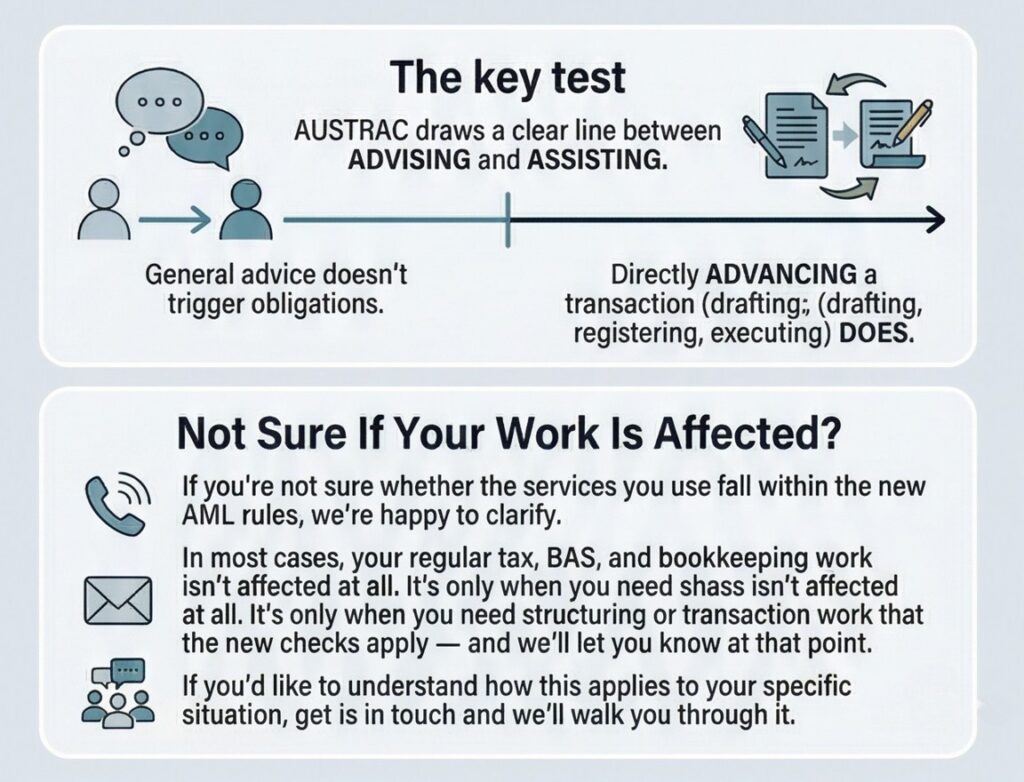
The key test
AUSTRAC draws a clear line between advising and assisting. Giving you general advice about the pros and cons of a particular structure doesn’t trigger AML obligations. But the moment we start directly advancing a transaction — drafting documents, registering entities, executing transfers — the requirements kick in.
This distinction matters because it determines whether you’ll need to go through the due diligence process before the work can proceed. For your regular compliance work, nothing changes. For structuring and transaction work, expect a new process.
Not Sure If Your Work Is Affected?
If you’re not sure whether the services you use fall within the new AML rules, we’re happy to clarify. In most cases, your regular tax, BAS, and bookkeeping work isn’t affected at all. It’s only when you need structuring or transaction work that the new checks apply — and we’ll let you know at that point. If you’d like to understand how this applies to your specific situation, get in touch and we’ll walk you through it.